By Nalinee Seelal
Monday, June 9 2008
newsday.co.tt
 A 25-year-old man and his baby son succumbed to their injuries after being shot several times while seated in a taxi at Picton Road, Laventille, on Saturday night.
Anthony Jones died at the Port-of-Spain General Hospital at about 11 pm, while his five-month-old son Zion, succumbed to gunshot injuries about 3 am yesterday at the Eric Williams Medical Sciences Complex.
Continue reading Dad, baby shot dead
 “I will take on from the PM to the cook. I don’t care what office you hold in this country. I don’t care what office you hold in this party. If you challenge my reputation then the war is on,” Member of Parliament for Diego Martin West Dr Keith Rowley announced yesterday as he addressed supporters in his Diego Martin Constituency 4th annual conference at the Pt Cumana Regional Com-plex, Carenage.
 I heard one of the talking heads on CNN, Tuesday night, talking with some relish – if not awe – of the fortuitous happenstance that sees Barack Obama winning the Democratic nomination (not that Ms Clinton doesn’t seem about to do her damnedest to prevent it, good sense, though, ultimately bound to prevail) on the anniversary of the very day that Martin Luther King gave his now legendary “I Have a Dream” speech.
 WITH 27 years of writing columns under my belt-I once wrote two columns a week, but never scaled Keith Smith’s one-a-day heights-how well I recall sitting before a typewriter and pondering for hours: what topic shall I choose today? At this sordid point in our nation’s history, that question has reversed itself: what do I not write about? Which is a hell-of-a-dilemma: it’s a sign of the times we live in. So much to write about, so little space.
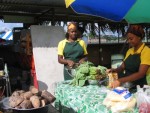 During the forties and the fifties, Corpus Christi was planting day. On that day, my mother and my brother planted every available piece of land around our house with corn, peas, dasheen bush, tanais and yams. These crops were supplement by breadfruits, a slave food, spinach which grew wildly around the village, mangoes, an import from India, tomatoes, a native plant from South and Central America, and a host of other fruits and vegetables. We purchased cow’s milk from our Indian neighbors who lived in the gutter (El Dorado) and sometimes the Scotts would supply us with goat milk.
 ATTORNEY GENERAL Brigid Annisette-George was yesterday accused of taking the country one step closer to a secret government as lawyers, constitutional and public service experts criticised her for, on Tuesday, blocking parliamentary questions on the legal fees paid to private attorneys for State briefs.
 For many decades Scandinavian countries-Norway, Sweden, Denmark and Finland-have ranked highest in the world in economic and social indices. Far from being endowed with an abundance of natural resources, these countries wisely used what little they had (except Norway, which became oil-rich in the 1970s) to develop societies that are at the upper spectrum of global rankings in just about every field. They rank among the top ten countries in income distribution (rich-poor gap), per capita gross national income (GNI), and several other globally accepted indicators of successful countries.